

IPTV vs Cable TV in 2026: The Complete Cost Comparison

The short answer on IPTV vs cable: IPTV costs substantially less per month and asks for no long contract, while cable delivers more predictable reliability and bundles licensed content with the infrastructure to carry it. Which one wins depends less on the price tag than on how good your home internet is and how much you value not being tied down.
This comparison covers what each actually costs, what each actually gives you, and where cable genuinely still holds the advantage — because it does, and any guide that pretends otherwise is selling you something.
The Core Difference in One Paragraph
Cable television reaches you through dedicated physical infrastructure: a coaxial line into your home, a set-top box, and a network built for one purpose. IPTV reaches you through the broadband connection you already pay for, using an app on a device you probably already own. That single structural difference explains nearly every other difference in the IPTV vs cable comparison — the pricing, the flexibility, the reliability, and the failure modes.
If the concept is new to you, our guide to what IPTV is explains the mechanics in plain language.
IPTV vs Cable: The Monthly Cost
Money is why most people start looking at this comparison, so let’s be specific about where it goes.
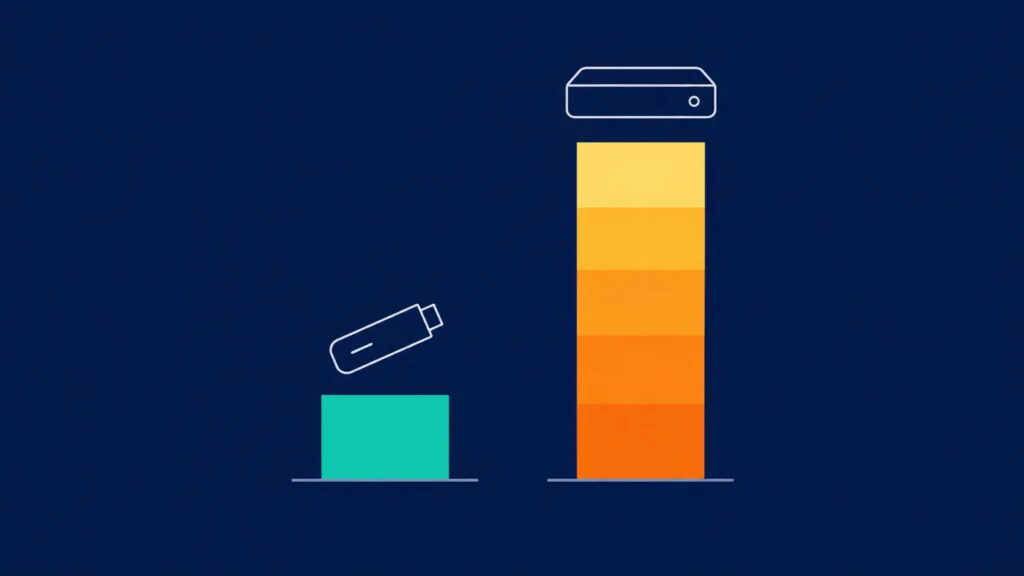
IPTV pricing sits between roughly $5 and $15 per month, driven mainly by plan length. Our own subscription plans run $12.99 for one month down to $69.99 for twelve months — about $5.83 monthly on the longest plan.
Cable pricing varies enormously by country, provider and package, so treat any specific figure you read online with suspicion. What holds true almost everywhere is the shape of the bill:
| Cost element | IPTV | Cable TV |
|---|---|---|
| Base subscription | $5–$15/month | Typically several times higher |
| Equipment rental | None | Common, per box, monthly |
| Installation | None | Often charged upfront |
| Additional room/box | Usually included in connection limit | Usually a separate monthly charge |
| Contract length | 1–12 months, ends when paid period ends | Commonly 18–24 months |
| Early exit fee | None | Common |
| Price after intro period | Unchanged | Frequently rises sharply |
That last row matters more than people expect. Introductory cable pricing routinely expires after twelve months, and the rate that replaces it is the real price. When comparing IPTV vs cable honestly, compare against the post-promotional cable rate, not the advertised one.
The Hidden Costs on Each Side
Neither option is quite as clean as its headline number.
IPTV’s unadvertised costs are modest but real. You need a stable broadband connection — which you likely already have. Some player apps charge a few dollars once. An older streaming stick may need replacing. An ethernet adapter, around $15, solves more problems than anything else you could buy. Total first-year extras: roughly $0 to $75, most of which you already own.
Cable’s unadvertised costs tend to be recurring rather than one-off: box rental per television, regional service fees, administrative charges, and the price increase that arrives once your promotional period ends. These are individually small and collectively significant.
Check your actual current bill line by line before making this comparison. Most people discover their cable cost is higher than they’d have guessed.
IPTV vs Cable: What You Actually Get
Price is only half the equation. Here’s where each option genuinely differs in what it delivers.
Reliability — Cable Wins This
This is the honest part that most IPTV articles skip.
Cable runs on dedicated infrastructure built for television. It does not compete with your household’s video calls, game downloads or someone streaming in another room. When cable fails, it usually fails for a whole neighbourhood and gets fixed as an outage.
IPTV rides on your broadband. If your connection is unstable, congested at peak times, or delivered over weak Wi-Fi, your viewing suffers — and the provider cannot fix your home network for you. Our buffering troubleshooting guide exists precisely because this is the most common complaint in the category.
If your broadband is genuinely poor and cannot be improved, that fact settles the IPTV vs cable question on its own, regardless of price.
Flexibility — IPTV Wins Clearly
Cable ties you to a contract, a physical installation, and an address. Moving home means transferring service, scheduling a technician, and sometimes starting a new contract term.
IPTV ties you to nothing beyond the period you paid for. There’s no installation appointment, no technician, no hardware to return. You watch on devices you already own — Fire TV, Smart TVs, Android, Apple devices, phones and computers — and when the period ends, it simply ends.
For anyone renting, moving frequently, or living between two places, this is the decisive factor in the IPTV vs cable decision.
Picture Quality — It Depends
Cable delivers consistent quality because bandwidth is dedicated and predictable. You get what the package specifies, reliably.
IPTV quality depends on a chain: the source content, your internet stability, your device’s age, and the player app. When every link is sound, quality matches or exceeds cable. When one link is weak, the whole chain shows it.
Stability matters more than raw speed here. A steady 25 Mbps outperforms an erratic 100 Mbps every single time. The FCC’s broadband speed guide gives reasonable baseline figures, and Ofcom publishes research on why advertised speeds and delivered speeds diverge so often. Test your own connection at Speedtest during the evening, not the morning — the evening number is the one that governs your viewing.
Setup — IPTV Is Faster, Cable Is Easier
Cable arrives installed. A technician visits, connects the line, leaves you a working box. Nothing to configure, but you wait for the appointment.
IPTV takes about fifteen minutes and no appointment: install a player app, enter your sign-in details, start watching. Our installation guide covers each device family step by step, and IPTV for beginners covers the concepts first if you’d rather understand before you start.
The trade-off is real. Cable requires zero technical confidence. IPTV requires a small amount — enough to install an app and type credentials correctly.
Customer Service — Different, Not Simply Better or Worse
Large cable operators run formal support infrastructure: phone lines, ticket systems, engineer visits, published service standards. It’s structured, and it’s often slow.
Smaller IPTV providers typically offer direct, informal contact — in our case WhatsApp and phone, answered by people rather than menus. Faster when it works. But quality varies wildly across the market, and plenty of cheap providers offer effectively no support at all.
This is the sharpest warning in the whole IPTV vs cable comparison: test a provider’s support before you pay. Message them a real question and see what comes back. You can test ours by contacting our team.
Which Should You Choose?
Neither option wins universally. Here’s the honest split.
Choose cable if
- Your broadband is slow, unstable, or capped, and cannot be upgraded
- You want zero technical involvement of any kind
- You’re in a household where reliability outranks cost entirely
- You need a formal service-level guarantee for business reasons
Choose IPTV if
- You have a stable broadband connection you’re already paying for
- You want to avoid multi-year contracts and early-exit fees
- You watch across several devices, or away from the main television
- You move home, travel, or rent
- The monthly saving genuinely matters to your budget
Consider running both briefly
There’s no rule requiring a clean switch. Take a one-month IPTV plan while your cable is still active. Watch both during peak evening hours on the same television. After four weeks you’ll know from experience rather than from an article which one suits your home — and you’ll have risked $12.99 to find out.
Frequently Asked Questions
Is IPTV cheaper than cable TV?
Per month, yes — usually by a wide margin, especially once cable equipment rental and post-promotional pricing are counted. The gap narrows if you need to upgrade your broadband to support streaming properly.
Is IPTV as reliable as cable?
Not inherently. Cable uses dedicated infrastructure; IPTV depends on your home internet. With a stable wired connection, the practical difference is small. With weak or congested Wi-Fi, cable is noticeably steadier.
Do I need to cancel my cable to try IPTV?
No. Run both for a month. It’s the only way to compare them under your actual conditions rather than in theory.
What internet speed do I need for IPTV?
HD generally needs a reliable connection of around 10 Mbps or more; 4K needs considerably more. Consistency matters more than peak speed. Our FAQ page covers this in more detail.
Can I keep my existing television?
Yes. Any television works — directly through a Smart TV app, or through a streaming stick on an older set. No proprietary box is required.
Does IPTV replace cable completely?
For most households with decent broadband, yes. For homes with unreliable internet, IPTV complements cable better than it replaces it.
The Bottom Line
The IPTV vs cable decision comes down to a straightforward trade. Cable sells you certainty: dedicated infrastructure, guaranteed bandwidth, formal support — at a higher price, on a longer contract, with equipment fees attached. IPTV sells you flexibility and a lower cost, and asks in exchange that your home internet be good enough to carry it.
If your broadband is solid, IPTV is the better value by a clear margin. If it isn’t, fix that first — no subscription of any kind compensates for a connection that can’t deliver.
Ready to compare properly? Our subscription plans show every price in full, and you can message our team on WhatsApp with questions before paying anything.